

⚡ Quick Verdict
| Overall Score | 8.3 / 10 — ⭐⭐⭐⭐ |
| Best For | Enterprise localization, game studios, real-time voice conversion |
| Starting Price | Custom / usage-based pricing; contact sales for enterprise plans |
| Core Technology | Voice cloning, real-time voice conversion, neural TTS |
| Standout Feature | Real-time voice conversion API for live applications |
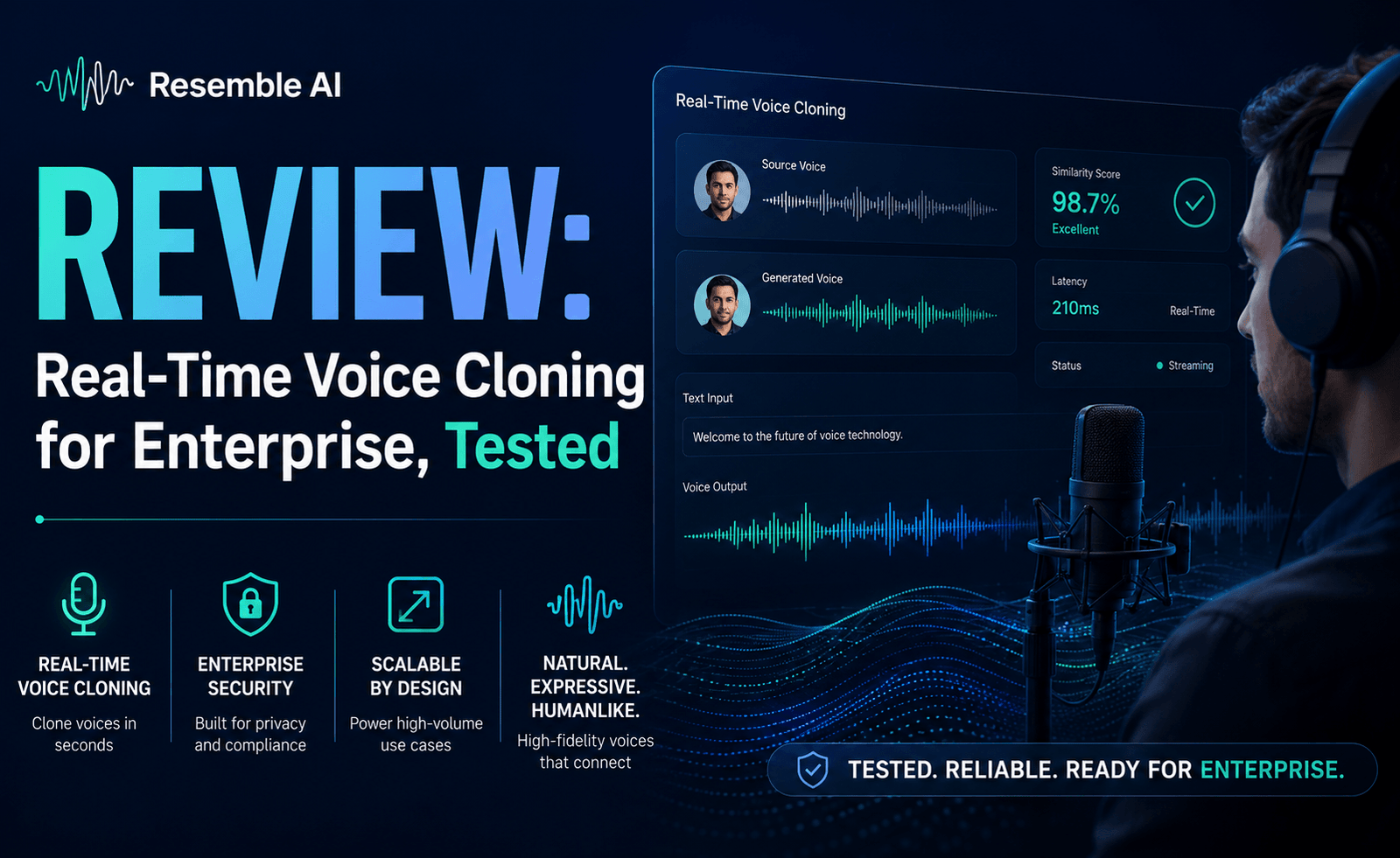
While most voice AI tools are built for content creators, Resemble AI leans more heavily toward enterprise and production use cases: game studios needing consistent character voices across thousands of lines of dialogue, media companies localizing content across markets, and developers building real-time voice conversion into live applications. Foremy tested Resemble’s cloning quality, real-time conversion capabilities, and enterprise-oriented tooling to see how it holds up for production-scale work.
Overview: What Is Resemble AI?
Resemble AI provides voice cloning, text-to-speech, and — notably — real-time voice conversion, which transforms one person’s live speech into a different target voice on the fly. This last capability sets it apart from most competitors, which generally require text input rather than accepting live audio as the source. The platform also emphasizes localization tooling, letting a cloned voice speak in additional languages while attempting to preserve the original vocal identity.
What We Tested
Our testing covered standard voice cloning from sample audio, text-to-speech output quality using cloned voices, real-time voice conversion latency, and cross-language voice consistency when the same cloned voice was used to generate speech in a second language. We also evaluated the enterprise dashboard and API documentation from the perspective of a production team integrating the tool into an existing content pipeline.
Voice Cloning Quality
Cloning results were strong, particularly when working from clean, well-recorded source audio — a common theme across every cloning tool we’ve tested, and Resemble is no exception in requiring good input to produce a good output. The cloned voices retained recognizable character and tone, and text-to-speech output using those cloned voices sounded natural on conversational scripts. Longer-form narration occasionally showed subtle fatigue in expressiveness compared to shorter clips, a pattern we’ve seen across several tools in this category rather than a Resemble-specific flaw.
Real-Time Voice Conversion
This is Resemble’s headline feature, and it’s genuinely differentiated. Speaking into the system and having it output a different voice in near real time worked more smoothly than we expected, with latency low enough to sustain a natural conversational back-and-forth in our testing environment, though performance was noticeably dependent on connection quality and hardware. This capability opens up use cases that pure text-to-speech tools simply can’t address — live-streamed content with a consistent “character” voice, real-time dubbing scenarios, or accessibility applications where someone’s live speech needs to be transformed on the fly. It’s a more specialized, technically demanding feature than standard TTS, and it shows in both the pricing and the setup complexity.
Cross-Language Consistency
We tested a cloned voice generating speech in a second language and found the vocal identity reasonably well preserved — recognizable as “the same voice” even when speaking an unfamiliar language, which is the core promise of the localization use case. Accent authenticity in the second language varied somewhat depending on the specific language pair tested, which is worth validating directly against your target languages before committing to a large localization project.
Enterprise Tooling & Documentation
Resemble’s dashboard and API documentation clearly reflect its enterprise focus, with detailed access controls, usage monitoring, and support for managing multiple cloned voices across a production team. This adds a bit of complexity for casual users but is genuinely valuable for game studios or media companies managing dozens of character voices across a large content pipeline.
Pricing & Plans
| Plan | Approx. Price | Best For |
|---|---|---|
| Free Trial | Limited credits | Evaluating cloning quality |
| Pay-As-You-Go | Usage-based | Smaller projects, occasional use |
| Business / Enterprise | Custom pricing | Studios, media companies, large-scale localization |
Note: real-time conversion and enterprise features are typically quoted individually — contact Resemble’s sales team for current rates before scoping a project.
Real-World Use Cases
Resemble made the most sense for teams with production-scale or technically demanding needs: game studios needing a consistent character voice across huge volumes of dialogue, media companies localizing video content into multiple languages while preserving speaker identity, and developers building live voice-transformation features into streaming or accessibility products.
Pros and Cons
✅ Pros
|
❌ Cons
|
How It Compares
Resemble occupies a different niche than ElevenLabs, Murf, or Play.ht — its real-time voice conversion isn’t really offered in the same form by the other tools in this roundup, making it the clear pick when live voice transformation is the actual requirement rather than standard text-to-speech.
Our Testing Methodology, In Detail
Given Resemble’s dual focus on standard TTS and real-time voice conversion, Foremy split testing into two tracks. For text-to-speech and cloning, we used our standard script battery — narrative, technical, conversational, and multilingual passages — generated from both a short instant-style clone and a longer, cleaner source recording to see how much cloning quality improved with better input data. For real-time conversion, we set up a live speech-to-speech test using a consistent script read aloud by a Foremy tester while the system converted it to a target voice in real time, measuring perceived latency and listening for artifacts like stuttering, pitch instability, or dropped audio, and repeating the test across both a strong, stable internet connection and a deliberately throttled connection to see how gracefully performance degraded.
We also tested the cross-language cloning claim directly by generating the same cloned voice speaking English, Spanish, and Mandarin scripts, and had a native or fluent speaker for each language assess how natural the accent and pronunciation sounded rather than relying solely on our own judgment.
Customer Support Experience
Because Resemble is positioned toward enterprise buyers, much of the pre-sales experience runs through a sales and solutions-engineering process rather than instant self-serve signup, which shapes the support experience considerably. Our interactions with the sales and support team during testing were knowledgeable and responsive, with a clear willingness to walk through specific use cases like localization pipelines or live-streaming integrations in detail. This is a meaningfully different experience than the largely self-serve support model of more consumer-oriented tools, and it’s a reasonable trade-off for buyers who need hands-on help scoping a technically complex integration.
Security & Privacy Considerations
Voice cloning and real-time conversion both raise heightened privacy and consent questions compared to standard TTS, and this is an area where Resemble’s enterprise focus shows up in the product’s access controls and audit features. Organizations using cloned voices in production — particularly for localization involving a real actor’s or executive’s voice — should have clear contractual consent and usage-rights agreements in place independent of anything the platform itself enforces. Real-time conversion in particular introduces novel questions around identity and authenticity that are still evolving from a regulatory standpoint in many regions, so legal review before deployment is worth the time investment for any customer-facing application.
Tips for Getting the Best Results
A stable, high-quality internet connection made a bigger difference to real-time conversion performance than any setting inside the platform itself, so teams building live applications should budget for solid network infrastructure as part of the deployment rather than treating it as an afterthought. For standard cloning projects, investing in a properly recorded source sample — quiet room, consistent microphone distance, minimal background noise — paid off noticeably more than any post-processing adjustment available in the dashboard. For localization projects, we’d recommend validating output with a native speaker of each target language before finalizing a large-scale rollout, since accent authenticity varied enough by language pair in our testing to be worth an extra verification step.
Who Should (and Shouldn’t) Use Resemble AI
Resemble is the right choice for game studios, media companies, and product teams with a genuine need for real-time voice conversion or large-scale, consistent-character voice cloning across a big content pipeline. It’s a weaker fit for individual creators or small teams with straightforward, one-off voiceover needs, where the setup overhead and enterprise-oriented pricing model are unlikely to be worth it compared to a simpler, more self-serve tool.
Final Verdict
Resemble AI is best understood as infrastructure for teams with production-scale or technically specialized needs rather than a casual content-creation tool. Its real-time conversion capability is genuinely impressive and hard to find elsewhere, but the pricing opacity and setup complexity mean it’s best suited to teams with a clear enterprise use case rather than solo creators. Foremy rates it 8.3 out of 10.
FAQ
What makes Resemble AI different from standard TTS tools?
Its real-time voice conversion feature can transform live speech into a different voice on the fly, rather than only generating speech from text.
Is Resemble AI good for solo creators?
It’s better suited to studios and enterprise teams with production-scale needs; solo creators may find simpler, more affordable tools sufficient.
How is pricing structured?
Pricing is largely usage-based and custom-quoted for enterprise features, so it’s worth contacting sales directly for an accurate estimate.
Does it support multiple languages for cloned voices?
Yes, cloned voices can generate speech in additional languages with reasonably well-preserved vocal identity, though accent quality varies by language pair.