

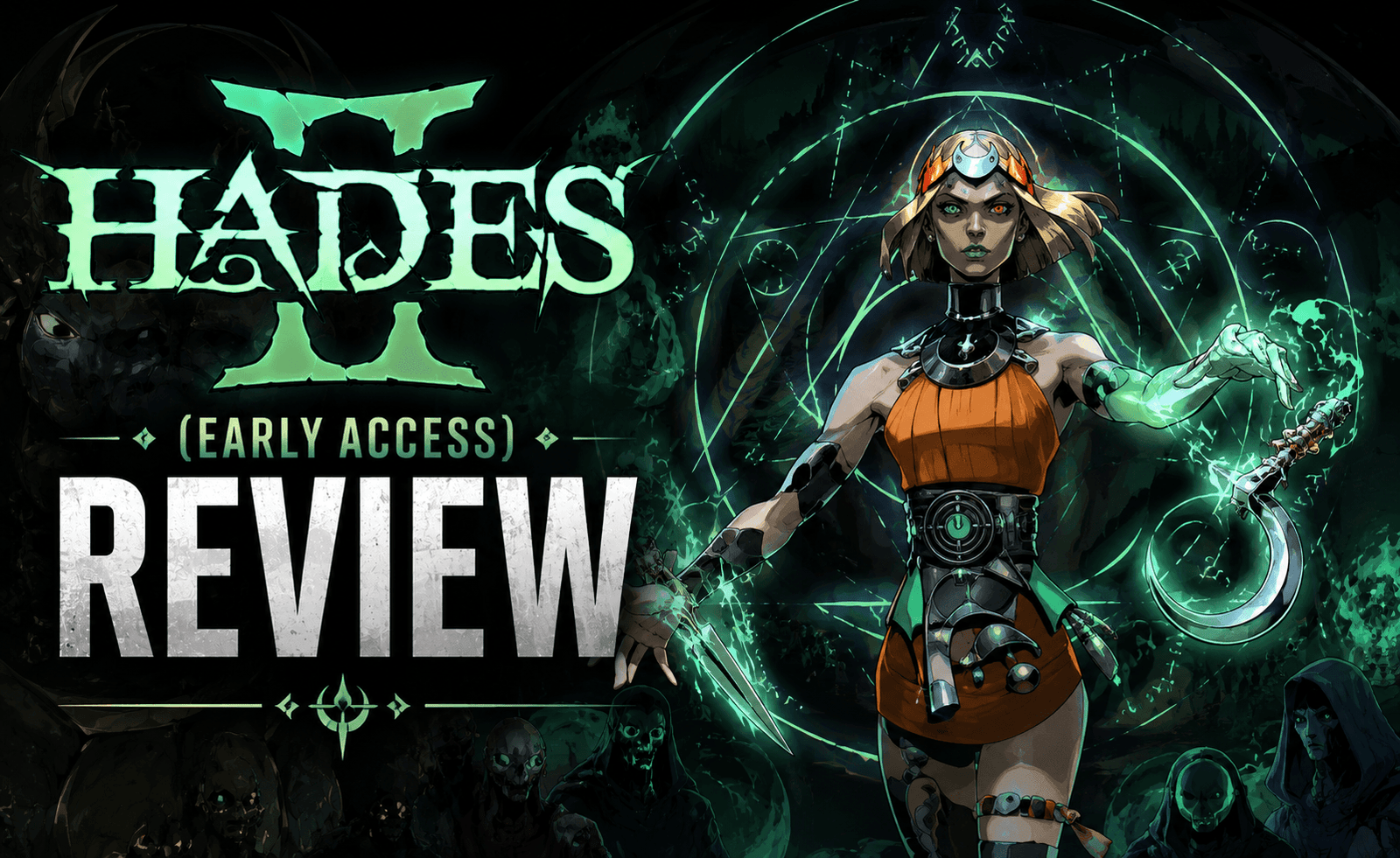
Following up the most acclaimed roguelike of its generation is a genuinely difficult task, and Hades II wisely avoids simply repeating what made the original special. Supergiant Games instead shifts protagonists, expands the mythological cast, and deepens the crafting and progression systems, all while still in early access. This review reflects roughly 40 hours across multiple biomes and several dozen runs, with the understanding that early access content is still being actively expanded.
📚Story and World-Building
Players take on Melinoe, princess of the Underworld and sister to the original game’s protagonist Zagreus, as she wages a covert war against the Titan Chronos, who has seized control of the Underworld in the time since the first game’s ending. The shift in protagonist and antagonist opens up an entirely new cast of gods and mythological figures to interact with, while still weaving in familiar faces for longtime fans.
Supergiant’s dialogue writing remains a genre benchmark. Relationship and story progression are tied to repeated runs rather than a single linear path, and the sheer volume of contextual, run-specific dialogue means conversations rarely feel repetitive even after dozens of deaths and returns to the home base.
⚔️Gameplay and Combat Systems
Combat retains the original’s fast, weapon-swapping action-roguelike foundation while introducing new systems: a dedicated spellcasting resource tied to Melinoe’s witch-in-training identity, an omega-move charged attack for each weapon, and a broader set of familiar companions that fight alongside the player. These additions layer meaningfully on top of the established Boon system rather than replacing it, giving veteran players a genuinely new toolkit to master.
Run structure has also expanded, with the current early access build supporting two distinct biome routes from the home base, adding welcome variety to the traditionally linear roguelike loop. Difficulty scaling through the Fated List of Minor Prophecies (this game’s equivalent of Heat) remains a satisfying, granular way to customize challenge as mastery improves.
“Supergiant had every excuse to just make Hades again. Instead, they made something that earns its own identity.”
🕑Progression and Early Access Content State
As an early access release, content volume is understandably smaller than the finished first game, particularly in the number of available biomes and story chapters, and some systems (crafting, familiar management) still show rough edges in balance and clarity. That said, the amount of fully voiced dialogue and narrative content already present significantly exceeds typical early access expectations.
Supergiant has committed to substantial content updates throughout the early access period, following the same model used successfully for the original Hades, and early patches have already added meaningful new story content, weapons, and biome expansions at a healthy pace.
🎧Graphics, Sound, and Performance
The hand-painted art style carries over with noticeably increased character animation fidelity, and the new Underworld-adjacent and surface-world biomes introduce fresh color palettes and creature designs that stand apart from the original’s aesthetic. On virtually any modern PC, performance is excellent; even modest hardware maintains a locked 60fps given the game’s stylized, low-poly-adjacent art direction.
Darren Korb’s score continues to be a standout, blending the original’s rock and folk influences with new witchy, percussive themes fitting Melinoe’s identity. Full voice acting across the entire (large and growing) cast remains consistently excellent, matching the bar set by the original game.
🎮Home Base, NPCs, and Crafting
The Crossroads, Melinoe’s home base between runs, mirrors the original House of Hades in function while introducing an entirely new roster of gods, witches, and mythological figures to build relationships with over time. Garden crafting and the incense-brewing system add a light management layer between runs, letting players cultivate ingredients that feed into permanent upgrades and unlockable dialogue.
These systems are clearly the least finished part of the current build, with a couple of crafting recipes feeling undertuned relative to the resource investment required, but the framework in place already suggests a satisfying loop once fully balanced. Given Supergiant’s track record of substantially refining systems like this throughout the original Hades’ early access period, there’s good reason for optimism about where this ends up by full release.
👤Who Should Play Hades II Now
Fans of the original Hades should not hesitate; this is already a substantial, polished experience despite its early access label, and Supergiant’s transparent, frequent update cadence makes buying in now a low-risk proposition. Newcomers to the series unfamiliar with the first game can also jump in comfortably, though playing the original first will add extra emotional weight to several returning characters and references.
Players who strongly prefer fully finished, content-complete releases may want to wait for the 1.0 launch, given that some systems are still being actively rebalanced. For anyone comfortable with early access as a concept, though, this is about as strong a starting point as the model gets.
🔄How It Compares to the Original Hades
Placed directly against the original, which remains one of the most acclaimed roguelikes ever released, Hades II is a genuinely fair fight in the areas it has already built out, particularly combat feel and dialogue quality, while understandably trailing in raw content volume given its early access status. Structural changes, like the addition of a persistent overworld hub connecting biomes and a second resource economy tied to witchcraft, show Supergiant isn’t content to simply reskin the original’s successful formula.
Whether it ultimately surpasses the original will depend heavily on how the remaining early access development period is used, particularly around expanding the current two-biome structure to match the first game’s full run length. Based on the trajectory so far, though, and Supergiant’s strong track record of using early access feedback effectively, there’s little reason to doubt they’ll get there.
💰Value for Money in Early Access
Priced below most full-release action games despite already offering dozens of hours of fully voiced content, multiple biomes, and a deep combat system, Hades II represents strong value even before accounting for the free content updates already delivered during early access. Purchasing now also grants automatic access to the full 1.0 release with no additional cost, functionally making it a discounted pre-order with immediate playable content attached.
Given Supergiant’s history of substantially expanding the original Hades throughout its own early access period at no extra charge to existing owners, there is strong reason to expect a similar trajectory here, making this one of the more comfortable early access purchases currently available on PC.
🏆Weapons and Playstyle Variety
Melinoe’s weapon roster currently spans six distinct arm types, each with its own moveset, special attack, and now-signature omega charged move, ranging from a fast dual-blade set favoring aggressive melee combos to a staff-based ranged option built around area-denial magic. As with the original game’s Aspect system, each weapon offers multiple unlockable variants that meaningfully shift its playstyle rather than simply adjusting numbers, giving committed players a genuinely deep well of build combinations to explore across repeated runs.
Boon selection, drawn from an expanded pantheon that now includes returning favorites alongside newcomers unique to this installment, continues to reward experimentation over settling into a single optimal build. Duo Boons, which require specific combinations of two gods’ blessings to unlock, remain one of the series’ smartest systems for encouraging players to try combinations they might otherwise overlook, and the sequel’s expanded god roster gives that system even more room to breathe. Even after dozens of runs, new combinations of familiar spirits, boons, and weapon aspects continue to surface fresh tactical options, which speaks well to the depth already present this early in the game’s development cycle. It’s a strong sign for how much further this system has room to grow once the full roster of gods and weapon aspects arrives at the eventual 1.0 launch, and it’s already enough to fill dozens of hours without repetition setting in.
✅ What We Loved
- Melinoe’s expanded combat toolkit meaningfully differentiates from the original
- Writing quality and voice acting remain best-in-class for the genre
- Strong early access content volume with an active, transparent update cadence
- Runs excellently even on modest hardware
- New biomes and mythological cast expand the world without undermining the original
❌ Where It Falls Short
- Content volume is still smaller than the finished first game, as expected for early access
- Crafting and familiar systems have rough balance edges
- Some systems are clearly still being iterated on and may change significantly before 1.0
Final Verdict — 8.8/10
Even in early access, Hades II demonstrates Supergiant’s rare ability to build a sequel that respects its predecessor without being beholden to it. It’s already an excellent roguelike, and the promise of continued content updates makes it easy to recommend now rather than waiting for a full release.
Reviewed by the Foremy Team on PC. Review copy details and testing methodology available on request at
foremy.com/.