

Mobile Games Review
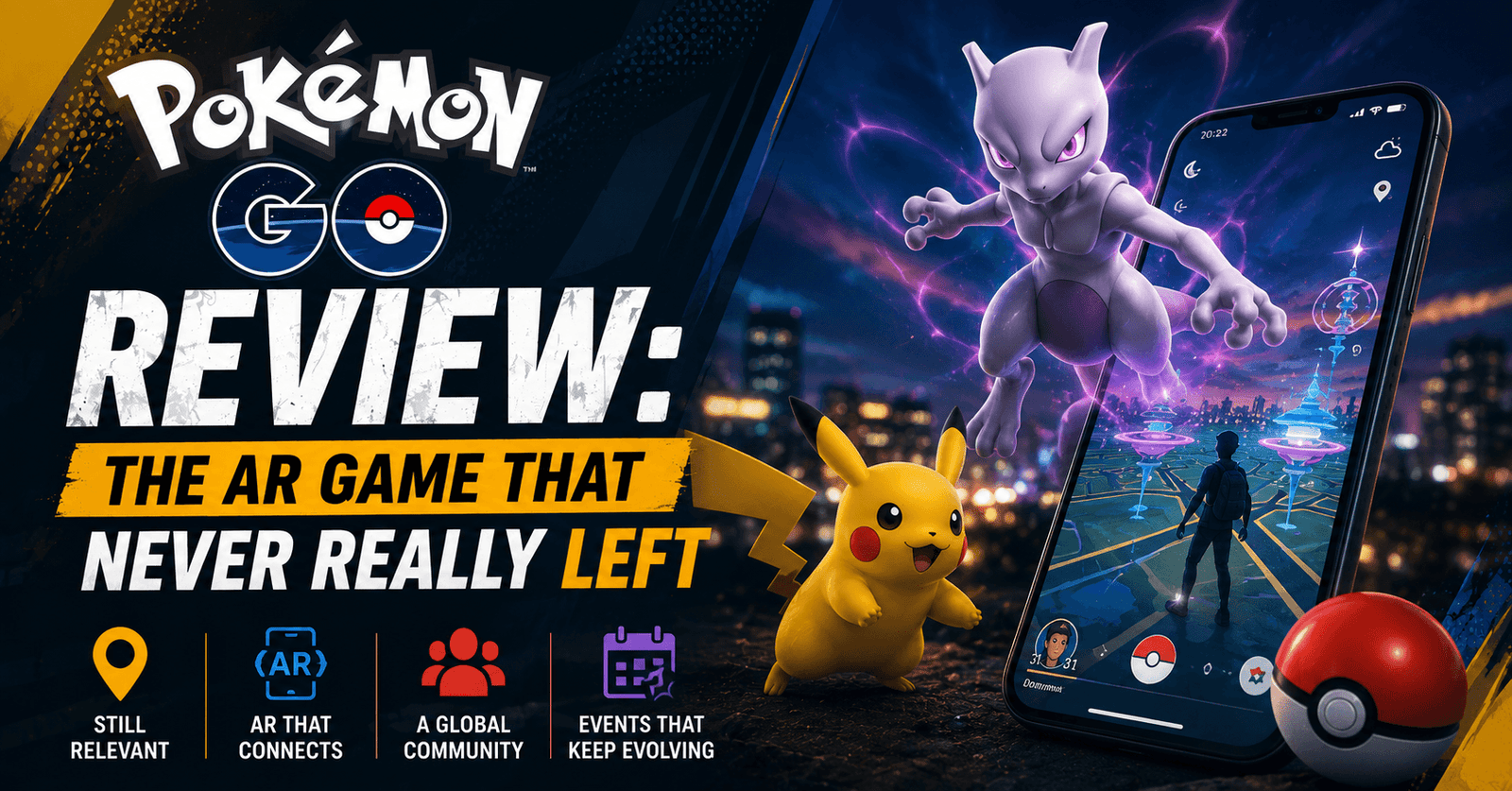
Pokémon GO Review: The AR Game That Never Really Left
By Foremy Team · Game Ratings / Mobile Games
FOREMY RATING
8.3/10
★★★★☆
Developer: Niantic / Pokémon Company
Genre: Augmented Reality / Collection
Platforms: iOS, Android
Price: Free-to-play with in-app purchases
When Pokémon GO launched, it briefly became a cultural phenomenon so large that entire cities reported foot traffic spikes around parks and landmarks. That kind of viral moment inevitably fades, and plenty of commentators assumed the game would fade with it. It didn’t. Years later, Pokémon GO still commands a loyal, genuinely massive player base, community events routinely fill public parks, and the game has quietly become one of the most consistent live-service success stories in mobile history. We spent a week catching, battling, and raiding to see how the experience holds up today.
What’s most interesting about Pokémon GO’s staying power is how little of it depends on nostalgia alone. New trainers who never experienced the original launch frenzy still find plenty to hook into, from an ever-expanding Pokédex that now spans generations well beyond the original 151, to a raid and battle system that has grown considerably more sophisticated than the simple “walk and catch” loop the game shipped with. Niantic’s willingness to keep iterating on systems that already worked, rather than resting on the game’s early cultural momentum, is a big part of why it hasn’t faded the way most viral mobile hits eventually do.

Still the Best Reason to Go Outside
The premise remains delightfully simple: walk around the real world, and Pokémon appear on your phone’s map for you to catch. That basic hook is still the game’s greatest strength. Few mobile games give you a genuine, sustained incentive to leave the house, and Pokémon GO does it by tying nearly every meaningful reward — eggs hatching, buddy candy, PokéStop spins, raid access — to actual physical movement. It’s one of the only games in this entire genre that can credibly claim to have improved players’ daily habits rather than just their screen time.
The augmented reality element has become optional rather than mandatory over the years, which was the right call. Pointing your camera at the real world to catch Pokémon is a fun novelty, but a simplified non-AR capture screen is faster, saves battery, and is honestly what most experienced players use for day-to-day catching.

Raids, Battles, and the Growing Endgame
What separates Pokémon GO today from its early, shallower version is how much endgame content has been layered on top of the core walking-and-catching loop. Raid battles let groups of players team up against powerful Pokémon for a shot at rare catches, and the difficulty scaling means low-level raids are approachable solo while the toughest ones genuinely require coordinated groups. GO Battle League brings player-versus-player combat with real strategic depth around typing, shields, and move timing, giving competitively minded players a reason to keep optimizing their roster long after they’ve filled out most of the regional Pokédex.
Niantic has also gotten much better at pacing special research storylines, which weave light narrative content around limited-time events. They’re not going to win any awards for writing, but they give structure and a sense of progression to events that would otherwise just be “catch more of this Pokémon for a few days.”
“It’s rare for a mobile game to still be pulling people into parks in large numbers this many years after launch — Pokémon GO’s community events remain genuinely special.”
Community Days and Live Events
Monthly Community Day events, where a specific Pokémon spawns at drastically increased rates for a few hours along with a bonus move for evolved forms, remain one of the smartest live-service tools in mobile gaming. They give the entire playerbase a shared reason to log in at the same time, and they turn public spaces into impromptu meetups where strangers trade tips and coordinate raids. Larger seasonal and city-based events amplify that further, occasionally drawing crowds substantial enough to require Niantic to coordinate with local authorities. Few games manage to translate a digital hook into that much real-world social energy.
Monetization and Fairness
Spending in Pokémon GO mostly buys convenience — extra storage, incubators, raid passes, and cosmetic items — rather than direct power. You can absolutely play at a high level, including competitive GO Battle League, without spending money, though remote raid pass availability has become a genuine point of community frustration after pricing and availability changes reduced how easily players outside major cities can participate in raids without traveling. It’s a fair complaint, and one of the few real blemishes on an otherwise player-friendly monetization approach.
Battery Life and Practical Concerns
Because the game relies on GPS and screen-on time to track movement, it remains one of the more battery-intensive mobile games you can play, especially with AR features or the battery saver mode disabled. Playing during a long outdoor session without a portable charger is a real risk, and it’s worth planning around if you’re heading out specifically to play for hours.
Building Your Roster: Collection vs. Competitive Play
Pokémon GO essentially splits into two overlapping games, and understanding that distinction early makes a big difference in how satisfying the experience feels. There’s the collection layer — catching new species, hatching eggs, completing regional Pokédex entries, and hunting for rare shiny variants — which rewards patience and casual, low-pressure play. Then there’s the competitive layer built around GO Battle League and raid optimization, which demands a much more deliberate approach to IV values, move sets, and typing coverage. Trying to optimize for both simultaneously as a brand-new player can feel overwhelming, so we’d recommend focusing on the collection game first, letting your Pokédex and item stockpile grow naturally, and only diving seriously into PvP once you have a comfortable buffer of resources and a rough sense of which Pokémon you enjoy using.
Trading and friendship mechanics add another layer worth exploring once you’ve settled into the basics. Building friendship levels with other trainers unlocks better trade bonuses and occasional gift bonuses, and trading remains one of the most reliable ways to fill Pokédex gaps for region-exclusive species without needing to travel.
Practical Tips for New Trainers
Enable battery saver mode from the start — it dims the screen when the phone is face-down in your pocket while still tracking distance for eggs and buddy walking, and it’s the single most effective way to extend a play session without carrying a portable charger. It’s also worth joining a local or online community group early; raid coordination and trading are dramatically easier with even a small group of regular contacts, and most cities have active Discord or social media groups organizing meetups around Community Days and major events.
Finally, don’t feel pressured to catch or interact with every single spawn. The game generates far more content than any one session can reasonably use, and treating it as a background companion to your normal daily routine — rather than a demanding second job — is the sustainable way to enjoy it over the long term.
Pros and Cons
👍 What We Liked
- Genuinely encourages outdoor activity
- Deep raid and PvP endgame systems
- Excellent, community-driven live events
- Free players can compete at a high level
- Constant flow of new content and creatures
👎 What Could Be Better
- Heavy battery drain during active play
- Remote raid access has become more restrictive
- Players in rural areas get a noticeably thinner experience
Frequently Asked Questions
Can you play Pokémon GO without spending money? Yes, and comfortably so for the collection side of the game. Competitive PvP and consistent raid access do benefit from occasional spending, particularly for players outside dense urban areas, but the core loop of catching, hatching, and exploring remains fully playable for free.
Is it still active years after launch? Very much so. Community Days, seasonal events, and regional in-person gatherings continue to draw large numbers of active players, and Niantic has kept a steady cadence of new content and creature additions long past the point many expected the game to plateau.
Do you need to walk constantly to make progress? Not literally constantly, but movement is central to the core rewards loop. Even modest daily walking, combined with efficient use of incense and lures at busy PokéStops, is enough to make steady progress without needing to dedicate hours specifically to walking routes.
Is it beginner-friendly today? Yes — the current tutorial and early-game pacing do a much better job onboarding new trainers than the game did at launch, and low-level raids and research tasks are specifically calibrated to be approachable without a large existing collection.
Final Verdict
Pokémon GO has aged into something more impressive than its viral launch ever suggested it could become: a genuinely deep, community-driven live-service game that still gets people outside and talking to strangers over shared enthusiasm for cartoon monsters. It’s not without real flaws, particularly around geographic fairness and raid accessibility, but as an experience that blends mobile gaming with the physical world, nothing else has matched it since.
Reviewed by the Foremy Team. Foremy covers ratings and reviews across every genre of mobile gaming — visit us at foremy.com/ for more.