

Game Ratings › Console Games
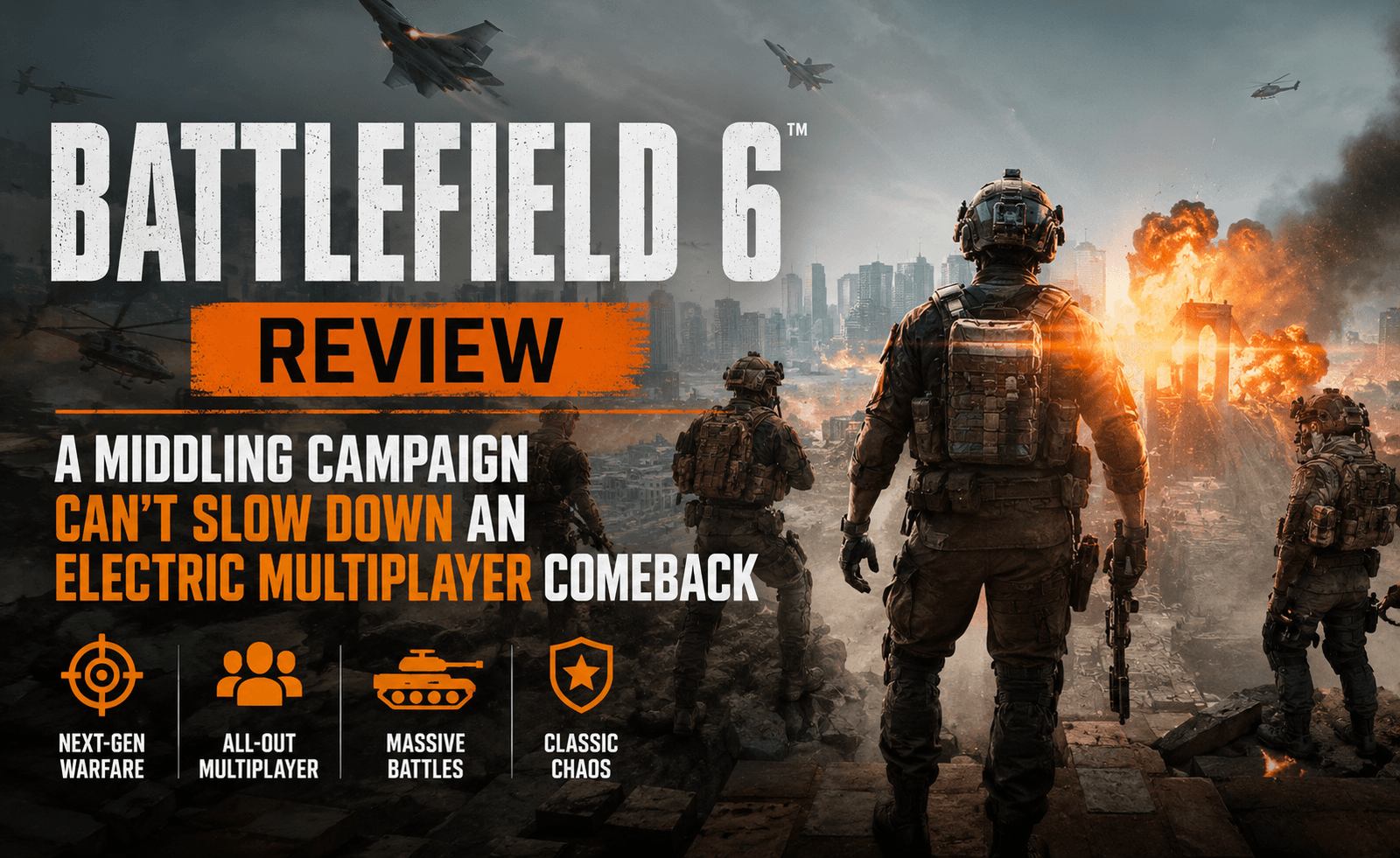
Battlefield 6 Review: A Middling Campaign Can’t Slow Down an Electric Multiplayer Comeback
Platforms: PS5, Xbox Series X|S, PC | Developer: Battlefield Studios | Genre: Military First-Person Shooter
/ 10
Foremy Verdict: Very Good
A forgettable single-player campaign is completely overshadowed by some of the best large-scale multiplayer the series has offered in years.
It has become something of a ritual with modern Battlefield games: judge the multiplayer generously, forgive the campaign quickly, and hope the community sticks around long enough for the game to find its footing. Battlefield 6 follows that pattern almost exactly, but with one important difference — the multiplayer here is good enough that forgiving the campaign barely feels like a compromise at all. After extensive time in both modes across console, this is a game defined far more by its highs than its lows.
The Campaign: A Story That Never Finds Its Footing
Let’s address the weaker half first. Battlefield 6’s single-player campaign follows a small squad through a fractured modern conflict, and on paper it has the ingredients for a strong military shooter story — a tight-knit unit, morally murky objectives, large-scale set pieces. In practice, the writing rarely rises above genre boilerplate, characters are thinly sketched, and mission pacing swings unevenly between overlong vehicle sections and abrupt, scripted story beats that don’t land with the weight they’re clearly aiming for. At around six hours, it is mercifully short, which is probably for the best; there simply isn’t enough narrative or mechanical variety here to justify a longer runtime, and a few missions feel like they exist purely to show off tech demos for the game’s engine rather than to serve the story.
That said, the campaign is not without merit purely as a sandbox showcase. A handful of large-scale battle sequences, where the game’s signature destruction tech is used to level entire buildings around you mid-firefight, are legitimately thrilling in the moment, even if the surrounding narrative struggles to give them proper context. Series veterans going in with tempered expectations for the story will likely still find a few standout action sequences worth playing through once.
Multiplayer: This Is Why You’re Really Here
Where Battlefield 6 truly comes alive is in its multiplayer, and specifically in its commitment to the large-scale, chaotic, systemic warfare that defines the series at its best. Sixty-four player battles across sprawling maps built for combined-arms warfare — infantry, armor, and air working in tandem — feel more cohesive and readable than in recent entries, with map design that gives every vehicle class a clear tactical role rather than letting any single element dominate. The classic four-class system (Assault, Engineer, Support, Recon) returns in a refined form, with clearer role identity and a weapon customization system deep enough to reward specialization without becoming overwhelming for newer players.
The series’ signature destruction remains a genuine differentiator against other military shooters on the market. Buildings crumble in ways that meaningfully change sightlines and cover mid-match, turning static maps into constantly shifting battlefields, and there’s real strategic depth in learning which structures can be collapsed to cut off an enemy’s advance or open a new flanking route. It is the kind of systemic depth that a scripted campaign simply cannot replicate, and it is where this engine and this design philosophy are clearly most at home.
Vehicle handling across tanks, helicopters, and jets feels tighter and more responsive than in the series’ recent history, striking a good balance between accessibility for newcomers and enough depth that dedicated vehicle mains can specialize meaningfully. Combined with genuinely excellent sound design — distant artillery, the physical rumble of a tank shell impact, the distinct crack of different weapon classes — multiplayer matches have a sense of scale and chaos that few other shooters on console currently match.
Launch Stability and Post-Launch Support
Console performance has been solid since launch, holding a steady frame rate even during the most chaotic sixty-four player engagements, and the developers have already shipped several rounds of balance patches addressing weapon tuning and a handful of exploit fixes. A clear post-launch roadmap of new maps, modes, and seasonal content has been outlined, which is reassuring given how much a Battlefield game’s long-term value depends on sustained content support rather than launch-day impressions alone.
How It Stacks Up
Against the current console shooter landscape, Battlefield 6’s core appeal remains its scale and destruction-driven systemic play, an identity that distinguishes it clearly from the tighter, faster loop of its most obvious competitor. Players looking for that specific large-scale, combined-arms chaos will find this to be one of the strongest entries the series has produced in years, even if it is not reinventing the formula so much as executing it with real confidence and polish.
What We Liked
- Best large-scale destruction the series has offered in years
- Refined four-class system with clear role identity
- Tight, responsive vehicle handling
- Stable console performance since launch
- Strong post-launch content roadmap
What Could Improve
- Campaign story and characters are largely forgettable
- Uneven campaign mission pacing
- Some multiplayer weapon balance still needs tuning
Progression, Customization, and Live-Service Elements
Beyond the moment-to-moment gunplay, Battlefield 6’s progression systems deserve real credit for striking a reasonable balance between long-term engagement and avoiding the more predatory monetization patterns that have plagued other live-service shooters in recent years. Weapon unlocks and attachments are earned through straightforward in-match progression rather than being gated behind convoluted challenge trees, and the pace at which new customization options unlock feels generous without trivializing the sense of earned progression that keeps players coming back match after match.
Cosmetic customization, meanwhile, is where the live-service elements are most visible, with a battle-pass style seasonal structure offering weapon skins, operator outfits, and vehicle liveries through both free and premium tracks. Critically, none of the cosmetic content we encountered felt like it crossed into pay-to-win territory; everything gated behind the premium track is purely visual, and the free track’s rewards are substantial enough that players who don’t spend beyond the initial purchase still have plenty to work toward each season. This is a meaningfully more consumer-friendly approach than some of the series’ own past missteps with premium currency and randomized unlock crates, and it’s a clear sign the studio learned from those earlier controversies.
The class-based specialization system also ties neatly into progression, letting players build out distinct loadout identities for Assault, Engineer, Support, and Recon roles independently rather than sharing a single generic unlock pool across all classes. This encourages experimentation with underused roles, since progress in one class doesn’t come at the expense of another, and it gives dedicated players a much clearer sense of a long-term specialization path if they want to main a particular role rather than bouncing between classes purely based on which weapons happen to be unlocked.
Squad-based play is also better incentivized than in some recent entries, with bonus experience and unlock progress tied to squad objectives like reviving teammates, resupplying ammunition, and capturing points as a coordinated unit rather than purely rewarding individual kill counts. It’s a small design choice, but it noticeably shifts public match behavior toward more cooperative play than the often chaotic, every-player-for-themselves feel that can plague large-scale shooters when only individual performance is rewarded.
Matchmaking and server stability, historically a rocky area for the series at launch, have also held up well in our time with the game, with quick queue times and consistently smooth sixty-four player lobbies across console. Cross-play between console and PC is on by default but can be disabled for players who would rather stick to a console-only pool, a small option that goes a long way toward keeping the playing field feeling fair for controller users who don’t want to be matched against mouse-and-keyboard opponents.
Voice communication and squad-coordination tools have also received welcome attention, with proximity-based voice chat for infantry squads adding a genuinely useful layer of tactical callouts during close-quarters building fights, on top of the standard squad channel most players will default to for coordinating pushes and vehicle requests. It’s a small thing, but in the chaos of a contested urban objective with buildings collapsing around you, being able to quickly call out a flanking enemy squad without fumbling for a text-chat menu makes a real difference to how coordinated even a group of strangers can feel within the first few minutes of a match.
Final Verdict
Battlefield 6 is a game of two very different halves, but it’s the half that matters most for this series that truly delivers. The campaign is a forgettable six-hour detour, but the multiplayer is a genuinely excellent return to form — large, chaotic, destruction-driven warfare that plays to every one of the series’ historic strengths. If you’re buying Battlefield 6 for the story, temper your expectations; if you’re buying it for sixty-four player combined-arms chaos with buildings crumbling around you, this is one of the strongest entries the series has produced in years.
Reviewed by the Foremy Team on PlayStation 5 and Xbox Series X. Review copy provided by the publisher for evaluation purposes.