

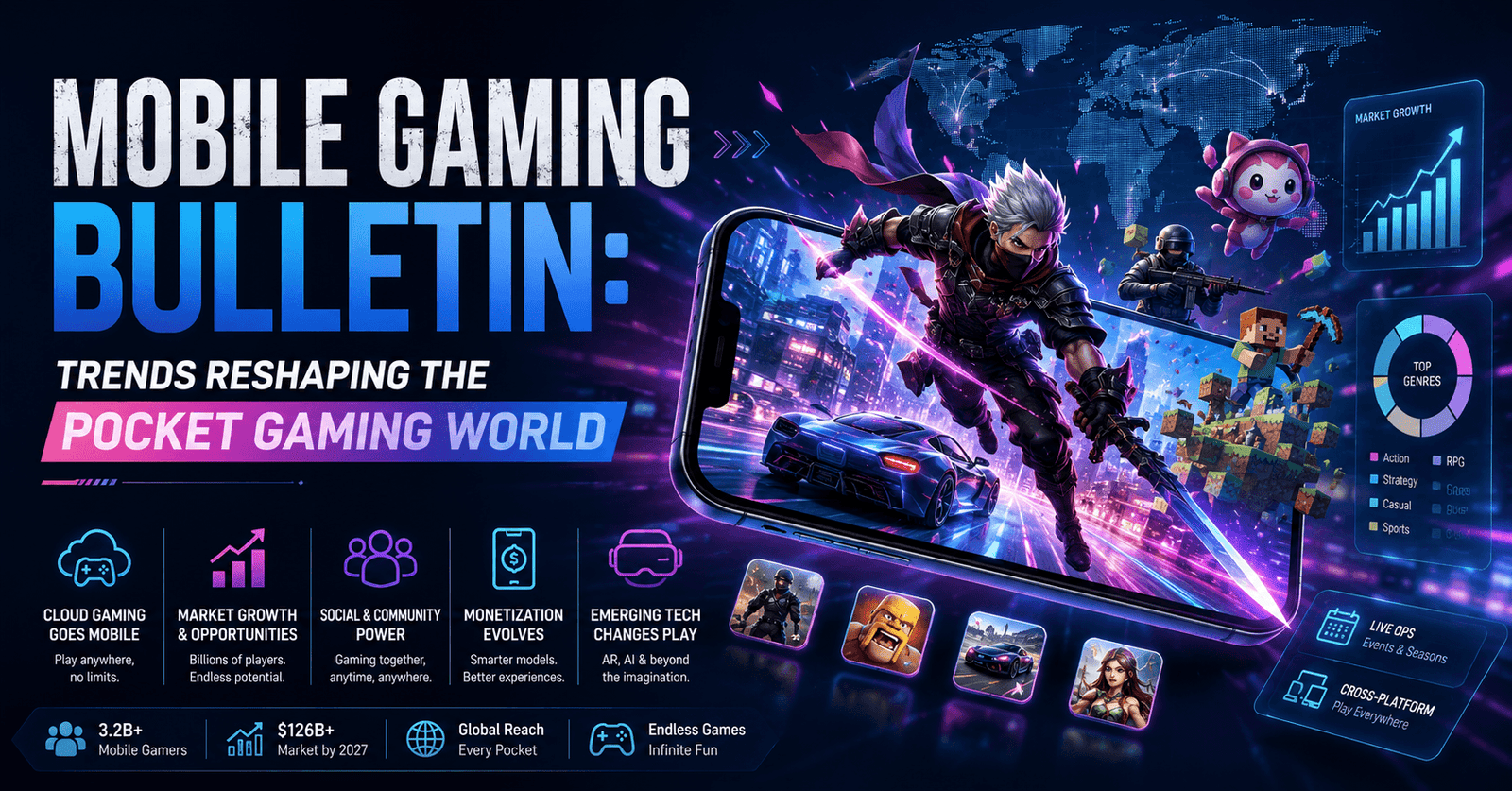
Mobile remains the largest gaming platform on the planet by sheer player count, even though it rarely gets the cultural spotlight console and PC gaming enjoy. This week’s bulletin looks at the trends quietly reshaping what mobile gaming actually looks like.
Quick Take:
- Premium, ad-free mobile titles are finding a sustainable niche audience
- Cross-platform mobile-to-console projects are becoming a genuine development strategy, not a marketing gimmick
- Player fatigue with aggressive monetization is starting to visibly affect retention metrics
- Cloud streaming is quietly turning phones into thin clients for much bigger games
Premium Mobile Titles Are Finding Their Footing
For years, the conventional wisdom in mobile development was that free-to-play with aggressive monetization was the only viable business model at scale. This week’s discussions suggest that assumption is being challenged by a growing, if still smaller, wave of premium mobile titles — games that charge an upfront price and skip ads and loot-box mechanics entirely.
These titles aren’t chasing the same install numbers as free-to-play giants, and nobody expects them to. But several developers shared revenue breakdowns this week showing that a smaller, more engaged premium audience can be more sustainable per-developer than chasing the free-to-play whale-spending model, particularly for small teams without the resources to run a live-service operation at scale.
This shift is being helped along by storefront curation efforts that specifically highlight premium and ad-free titles as a distinct category, making them easier for players who are actively looking for that experience to find, rather than getting buried under a wave of free-to-play releases.
Mobile-to-Console Isn’t Just a Marketing Gimmick Anymore
A notable structural trend this week: several studios are now designing mobile titles from the outset with a console or PC port as part of the core development plan, rather than treating a later port as an afterthought bolted on if the mobile version succeeds. This “mobile-first, platform-agnostic” design philosophy is producing games with control schemes and UI layouts that translate more gracefully across screen sizes than earlier generations of mobile ports typically managed.
The benefit for players is games that feel genuinely native on whichever platform they’re playing on, rather than an obviously mobile-shaped experience awkwardly stretched onto a television. The benefit for developers is a wider addressable audience without needing to build an entirely separate game for each platform.
“We stopped thinking of it as ‘the mobile game’ and ‘the console port.’ It’s one game with multiple front doors.” — a phrase used by more than one developer discussing their cross-platform approach this week.
Monetization Fatigue Is Showing Up in the Numbers
Perhaps the most consequential story in mobile gaming this week isn’t a specific announcement but a data trend: retention metrics across several high-monetization free-to-play titles are showing signs of fatigue. Players are increasingly bouncing off games faster when they hit aggressive paywalls or energy-timer mechanics, a pattern that wasn’t nearly as pronounced even a couple of years ago.
This is prompting some publishers to experiment — cautiously — with softer monetization approaches: cosmetic-only purchases, battle-pass structures with more generous free tiers, or straightforward one-time “remove ads” purchases replacing more aggressive rewarded-ad loops. It’s too early to call this a full industry pivot, and plenty of studios remain committed to the aggressive end of the monetization spectrum, but the fatigue signal is strong enough this week that it’s worth flagging as a trend to watch rather than dismissing as noise.
What Players Are Specifically Pushing Back On
- Energy or stamina systems that gate play time behind real-world timers
- Loot-box mechanics with unclear or poorly disclosed odds
- Aggressive rewarded-ad loops that interrupt core gameplay flow
- Battle passes with free tiers so thin they function as thinly veiled paywalls
Cloud Streaming Is Quietly Changing What “Mobile Game” Even Means
One of the more understated shifts this week involves cloud streaming’s growing role in mobile gaming. Rather than being confined to whatever a phone’s onboard chip can render, more titles are being delivered via streaming, effectively turning phones into thin clients capable of running console- or PC-caliber experiences.
This blurs the historical line between “mobile game” and “just a game you happen to be playing on your phone.” Several major titles previously considered console or PC exclusives saw expanded mobile streaming availability discussed this week, and community reaction has generally been positive, with the main lingering concern being network stability rather than the concept itself. Latency and data usage remain real barriers for a meaningful chunk of the potential audience, particularly outside areas with strong, affordable mobile broadband.
Regional Markets Are Diverging in Interesting Ways
Mobile gaming trends are far from uniform globally, and this week’s discussions highlighted some notable regional divergence:
- Certain regions continue to show strong appetite for highly social, guild-based mobile experiences with heavy live-events calendars.
- Other markets are showing increasing preference for shorter, single-session puzzle and hyper-casual formats, even as global attention on hyper-casual as a category has cooled somewhat overall.
- Premium mobile adoption is uneven across regions, correlating strongly with existing digital storefront payment infrastructure maturity.
This divergence makes a single global monetization or design strategy increasingly risky for publishers operating at scale — what works in one region can underperform significantly in another, and this week’s data reinforced that a one-size-fits-all mobile strategy is becoming harder to justify.
Community Corner
Mobile-focused community discussion this week included:
- Strong interest in premium mobile title recommendations, with several community-curated lists circulating widely.
- Ongoing frustration with app store discoverability, echoing similar complaints heard in the indie PC space.
- Debate over whether cloud streaming quality has genuinely reached a point where it can replace local hardware for competitive mobile titles.
- Appreciation for developers who’ve been transparent about loot-box odds disclosures ahead of regulatory requirements in various regions.
Parents and family-focused community groups have also been an active part of this week’s conversation, particularly around screen-time management tools and parental controls built directly into mobile platforms and individual titles. Several community members praised recent improvements to built-in reporting dashboards that give a clearer, less technical breakdown of how a child is spending time within a given game, rather than a raw playtime number with no further context. This kind of transparency tooling seems to be gaining genuine traction as a baseline expectation rather than a specialized feature only offered by a handful of family-oriented publishers.
What to Watch Next Week
- Further retention data from studios experimenting with softer monetization models.
- Additional mobile-first titles announcing simultaneous or near-simultaneous console ports.
- Expanded regional rollout of cloud-streamed mobile gaming services.
- Continued community pressure around monetization transparency.
Mobile Esports Is Building Its Own Identity, Not Copying Console Competitive Formats
An interesting subplot this week involves competitive mobile gaming carving out an identity distinct from the console and PC esports scene, rather than simply importing that scene’s conventions wholesale. Early attempts at mobile esports often tried to mirror traditional formats directly — arena venues, long best-of-five formats, production styles borrowed from PC competitive broadcasts. This week’s discussions suggest the format is maturing into something that leans into mobile’s actual strengths instead.
That means shorter match formats designed around mobile session-length norms, tournament structures that run comfortably over a single afternoon rather than a multi-day event, and viewing experiences optimized for vertical-format streaming consumption rather than the traditional horizontal broadcast layout borrowed from console esports. Several regional mobile tournament organizers highlighted this week that engagement metrics improve meaningfully when the format respects how their specific audience actually watches — often on the same device they’d otherwise be using to play, in short bursts throughout the day rather than a single dedicated viewing session.
Prize pools in mobile-specific competitive scenes remain smaller than their console and PC counterparts on average, but participation numbers, particularly in regions with strong mobile-first gaming cultures, are substantial, and growing faster in percentage terms than participation in more established competitive scenes. This suggests a genuinely large, if still developing, audience for mobile competitive content that simply hasn’t been well served by formats designed for a different platform’s viewing habits.
Signals Worth Tracking
- Continued growth in vertical-format competitive broadcast experimentation.
- Shorter, single-session tournament structures gaining traction over multi-day bracket formats.
- Regional prize pool growth outpacing global average growth rates in several mobile-first markets.
- Cross-promotion between mobile esports events and the broader creator economy, given how naturally short-form competitive clips fit existing social video platforms.
If this trajectory continues, mobile esports may end up looking meaningfully different from its console and PC counterparts within a few years — not a smaller imitation of the existing competitive scene, but its own distinct competitive culture shaped by the platform’s own strengths rather than borrowed conventions.
Editor’s Note
Mobile gaming rarely gets the cultural credit its player numbers deserve, but the trends shaping it this week — monetization fatigue, genuine cross-platform design, and the slow blurring of “mobile” as a distinct category thanks to cloud streaming — are arguably some of the most consequential in the entire industry right now, precisely because of how many players they touch.
That’s this week’s Mobile Gaming Bulletin. Charge your phone — you’ll need the battery.