

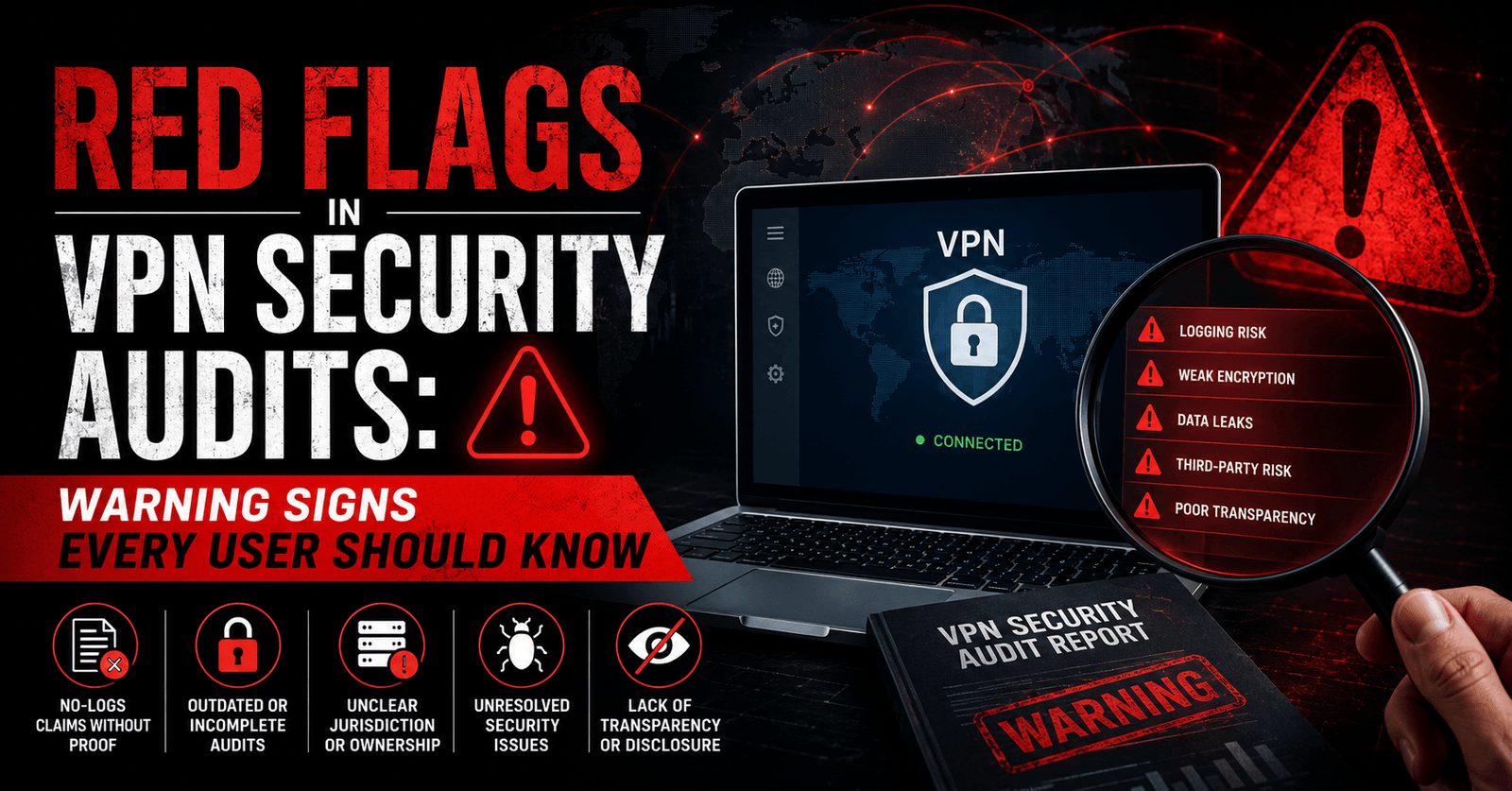
The word “audited” has become such a strong trust signal in the VPN industry that it’s now also become something providers are tempted to use loosely. Not every audit-shaped claim represents the same level of rigor, and learning to spot the warning signs takes only a few minutes once you know what to look for. This isn’t about assuming bad faith — it’s about applying the same healthy skepticism you’d bring to any unverified marketing claim.
Red Flag #1: No Published Report, Only a Press Release
If the only trace of an audit is a blog post or press release summarizing “great results” with no link to an actual report, that’s the single biggest warning sign. A genuine audit produces a document, and a provider confident in its findings usually makes at least a redacted or summarized version available. When there’s nothing to click through to, there’s nothing to verify.
Red Flag #2: Vague or Missing Auditor Identity
“Audited by a leading global cybersecurity firm” is a sentence that names nothing. A credible claim identifies the specific firm, ideally with a link to that firm’s own publication of the engagement or a case study page. If the firm’s name is withheld under the banner of “confidentiality,” that’s unusual — auditing firms typically want public credit for their client work, since it builds their own reputation.
Red Flag #3: A Suspiciously Old Audit Still Being Marketed as Current
VPN infrastructure and codebases change constantly. An audit from several years ago, still displayed prominently on a homepage with no newer engagement to point to, tells you very little about the product as it exists today. Watch specifically for the date of the audit versus the date of the marketing claim referencing it — a three-year gap with no repeat engagement is worth noting.
Red Flag #4: Zero Findings, Zero Detail
It might sound counterintuitive, but a report claiming that auditors found absolutely nothing wrong, with no findings listed at all, is often less reassuring than a report listing several Low or Medium findings that were subsequently fixed. Complex software almost always has something worth flagging; an audit that finds nothing across a broad scope more often suggests a shallow review than a flawless product.
A perfect score with no visible findings is a stranger result, statistically, than a report showing issues that were caught and fixed.
Red Flag #5: Scope That Doesn’t Match the Claim
Watch for a mismatch between what was actually tested and what’s being implied. A no-logs infrastructure review is not the same as a full application security audit, but marketing copy will sometimes blur the two together under a single “we’ve been audited” banner. Reading the scope section of the actual report — not the summary of it — is the only reliable way to catch this.
Red Flag #6: No Remediation or Retest Information
If a report lists findings but gives no indication of whether they were fixed, or includes no follow-up retest confirming the fixes actually worked, the audit tells you about a problem that existed at one point without telling you whether it still exists. The strongest reports include a clear remediation status for every finding and, ideally, an independent retest.
Red Flag #7: The Auditor Also Sells the Provider’s Product or Services
A genuinely independent audit requires the auditing firm to have no commercial stake in a favorable outcome. If the same firm performing the audit also has an affiliate marketing relationship, reseller agreement, or joint press arrangement with the VPN provider, that’s a conflict of interest worth factoring into how much weight the results deserve.
Red Flag #8: “Audit” Used Interchangeably With “Certification”
Some providers describe a routine compliance certification (which typically checks documentation and process against a standard checklist) as though it were equivalent to a hands-on security audit (which typically involves active testing). These serve different purposes, and treating a compliance certificate as proof of deep technical security testing overstates what actually happened.
A Practical Checklist for Spotting a Weak Audit Claim
- Is there an actual report to read, or only a summary paragraph?
- Is the auditing firm named, and can its own history be verified independently?
- How recent is the audit, and has it been repeated since?
- Does the report include findings and remediation status, or just a conclusion?
- Does the scope match what’s being claimed in marketing language?
- Is there any visible conflict of interest between the auditor and the provider?
Red Flag #9: The Audit Is Only Mentioned in a Comparison Chart
Some third-party review sites and comparison pages include a simple checkmark column labeled “Audited: Yes/No” with no link, no date, and no further detail. This kind of secondhand claim, repeated across multiple sites without ever tracing back to an actual report, can create the appearance of consensus that doesn’t hold up once you try to find the primary source. Whenever possible, trace an “audited” claim back to the provider’s own trust or transparency page rather than relying on a comparison chart’s shorthand.
Red Flag #10: Language That Overstates What Was Tested
Phrases like “audited and proven unhackable” or “certified 100% secure” should be treated with immediate skepticism regardless of context. No legitimate security firm makes absolute guarantees like this, because no complex software can be proven completely free of vulnerabilities forever. When a provider’s own marketing uses this kind of absolute language, it’s worth checking whether the underlying report uses similarly absolute claims — it almost never does, which tells you the overstatement is coming from marketing, not from the auditors themselves.
Putting It All Together: A Worked Example of Healthy Skepticism
Imagine a VPN homepage states: “Audited by a top security firm — zero vulnerabilities found!” A healthy verification process looks like this: first, search for the actual report rather than the sentence describing it. If none exists publicly, that’s already a significant red flag on its own. If a report does exist, check who performed it and whether that firm has a discoverable public history. Then check the scope — does “zero vulnerabilities” refer to the entire product, or just one narrow piece of infrastructure? Then check the date — is this recent, or is a five-year-old report being presented as though it reflects the current product? Each of these steps takes only a minute or two, but together they turn a single flattering sentence into an evidence-based judgment.
Why This Level of Scrutiny Is Reasonable
It might seem excessive to apply this much scrutiny to a single marketing claim, but it’s worth remembering what’s actually at stake: a VPN sees a complete record of where you connect and, depending on configuration, what you do there. That’s a meaningfully higher-trust relationship than most software asks for, which is exactly why the claims deserve a correspondingly higher bar of verification rather than being taken at face value simply because they sound reassuring.
How to Respond When You Spot a Red Flag
Spotting one of these warning signs doesn’t necessarily mean writing off a provider entirely — it means gathering more information before deciding how much weight to give the claim. A reasonable next step is reaching out to the provider’s support or press contact directly and asking specific questions: which firm performed the audit, when, and is the full report available? A provider with a genuinely strong audit behind it usually welcomes this kind of question and can answer quickly and specifically. A provider that responds evasively, delays, or repeats the same vague marketing language without adding detail is itself useful information, separate from whatever the original audit claim turns out to be.
A Note on Giving Credit Where It’s Due
It’s worth balancing this list of red flags with an acknowledgment that a growing number of VPN providers do get this right — publishing full reports, naming reputable firms, commissioning repeat engagements, and being transparent about findings and fixes. Recognizing genuinely rigorous audit practices, and being willing to say so clearly, is just as important as catching the weaker examples. The goal of applying this checklist isn’t cynicism toward the industry as a whole; it’s making sure the providers doing this work properly get recognized for it, while the ones cutting corners don’t get an unearned benefit of the doubt.
Building a Personal Habit Around This Checklist
The most practical way to use everything above is to treat it as a five-minute habit rather than a one-time deep investigation. Whenever a provider’s audit claim influences a decision worth making carefully, take a moment to look for the report itself, check who performed it, note the date, and skim the findings and remediation sections. Over time, this becomes fast and almost automatic, and it consistently produces a clearer picture than relying on the confidence of the marketing copy alone.
Conclusion
None of these red flags mean a provider is acting in bad faith — audits are expensive, complex to commission, and genuinely hard to get exactly right. But as a user trying to decide which claims to trust, treating “audited” as a starting point for a few minutes of verification, rather than a finished conclusion, is the single most effective habit for separating a rigorous, meaningful review from a marketing flourish wearing the same label.